sábado, 21 de junho de 2008

TARZAN Termagani

Contribuição de Alexandre Ribeiro (Portugal)
(EUA, 1912 ; 1929 na BD)"TARZAN DOS MACACOS" - "O REI DA SELVA"(CONTINENTE AFRICANO - SÉCULO XX)


Nascido em 1912, fruto da imaginação e da inspiração do escritor norte-americano Edgar Rice Burroughs (1875-1950), "Tarzan" é talvez o maior mito do século XX e a mais duradoura referência da moderna cultura popular, surgida do cruzamento do sonho com as técnicas de marketing. Com efeito, não será exagero considerar "Tarzan" o mais célebre herói de ficção do século passado, ultrapassando em popularidade outros heróis igualmente famosos, tais como "Tintin", "Astérix", "Rato Mickey", "Super Homem", "Flash Gordon", "Mandrake", "Fantasma", "Príncipe Valente", entre muitos outros.


"Tarzan" conseguiu, de facto, o feito extraordinário de estender o seu domínio a áreas tão diversificadas como a literatura, o cinema, a televisão, a rádio, a banda desenhada, os desenhos animados ou os jogos de vídeo. Ironicamente e de forma paradoxal, constata-se que se, por um lado, é ao cinema que a figura do "Rei da Selva" deve a sua fama universal e imortalidade, por outro lado, foi essa mesma "Sétima Arte" que mais distorceu o espírito inicial da criação do genial Edgar Rice Burroughs.Foi na edição de Outubro de 1912 da revista mensal "The All-Story" que começou a ser publicada uma espécie de fábula moderna intitulada "Tarzan of the Apes" ("Tarzan dos Macacos"), assinada pelo escritor Norman Bean, pseudónimo usado, inicialmente, por Edgar Rice Burroughs. Perante o êxito alcançado pela narrativa - que contava as atribulações e peripécias vividas pelo filho de um lorde inglês (Greystoke) que é educado por gorilas e chimpanzés na floresta equatorial africana - tanto o público leitor como o editor pediram a Burroughs que acrescentasse mais episódios e prolongasse as histórias por mais uns tempos.


A história de "Tarzan" inicia-se quando, na sequência de um naufrágio, o casal aristocrático inglês, Lord Greystoke, esposa e filho conseguem chegar a uma praia, na costa africana. Os seus pais morrem pouco tempo depois e deixam orfão o pequeno branco indefeso, que é recolhido e protegido por "Kala", uma grande fêmea gorila que o livra de uma morte certa. Criado no seio dos símios superiores na mais completa liberdade, o jovem "Tarzan" vai, progressivamente, adquirindo uma notável robustez e agilidade físicas e aprende, inclusivamente, a linguagem dos animais.


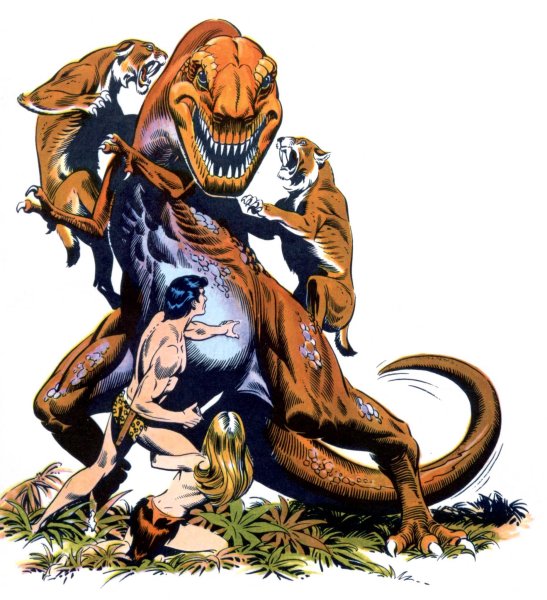
Mais tarde, "Tarzan" conhece uma rapariga chamada "Jane", que se torna a sua inseparável companheira de muitas aventuras pelos quatro cantos do planeta, penetrando em mundos fantásticos, como, por exemplo, quando descem ao centro da Terra ou visitam civilizações míticas perdidas na alvorada dos tempos.


Entretanto, "Tarzan" adquire um profundo sentido de humanidade e de justiça, pondo-se ao serviço dos indefesos e de causas nobres, combatendo tribos selvagens e homens brancos gananciosos e desonestos. Quando um dia, "Tarzan" descobre as suas próprias origens, regressa a Inglaterra e a Londres para uma curta estadia, mas rapidamente chega à conclusão de que o mundo dito civilizado e os costumes burgueses não são feitos para ele e decide, assim, regressar definitivamente à selva africana.Edgar Rice Burroughs destacou-se, sobretudo, pela sua inteligência intuitiva, possuindo uma grande inspiração criativa e imaginação, aliando a estas qualidades, um extraordinário dom de contar histórias e de criar climas de suspense. A África que utiliza para pano de fundo das suas narrativas e aventuras nada tem que ver com o continente real, pois trata-se de uma África "fantasma", "imaginária" e "irreal", habitada por povos estranhos, descendentes de antigos fenícios, romanos ou cruzados.


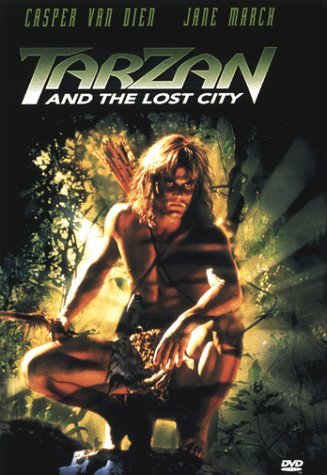
A aventura "The Return of Tarzan" ("O Regresso de Tarzan"), dada à estampa em 1913 e assinada já com o verdadeiro nome do autor, seguir-se-iam, em revista e em livro, até 1944 (seis anos antes da morte de Burroughs) mais algumas dezenas de títulos, num total de 43, incluindo romances e contos traduzidos para o mundo inteiro. A partir de 1918, as aventuras de "Tarzan" são adaptadas ao cinema, tendo sido produzidos, desde então e até hoje, cerca de 50 filmes deste herói, incluindo desenhos animados produzidos pela "Disney".


A adesão popular às histórias de Edgar Rice Burroughs foi de tal modo imediata que conduziu à exploração do herói em muitas e variadas direcções, entre as quais (a que nos interessa para o caso), a banda desenhada. Ao contrário do que se passou com o cinema, onde a transposição do espírito de Burroughs nunca foi totalmente conseguida, a banda desenhada só muito raramente se afastou do universo concebido pelo inventor de "Tarzan".
No início do ano de 1929, "Tarzan" passa também a ser adaptado para banda desenhada, aparecendo as suas aventuras oficialmente nos jornais diários americanos, distribuídos pelo "Metropolitan Newspaper Syndicate" (um ano mais tarde integrado no "United Features Syndicate"), sob a forma de tiras diárias assinadas por Harold Foster, um prestigiado publicitário reconvertido, entretanto, ao realismo figurativo da banda desenhada.
Harold Foster, o primeiro autor das tiras diárias, que aparecem pela primeira vez a 7 de Janeiro de 1929, desenha, assim, as 60 primeiras tiras, seguindo-se a este na série (que termina em 1973) os seguintes artistas: Rex Maxon (1929-36), William Juhré (1936-38), novamente Rex Maxon (1938-47), Burne Hogarth (1947), Dan Barry (1948-49), John Letti (1949), Paul Reinman (1949), Nicholas Viskardy (1950), Bob Lubbers (1950-54), John Celardo (1954-67) e Russ Manning (1967-73).Relativamente às "sunday pages" (páginas dominicais), surgidas pela primeira vez a 15 de Março de 1931, com a assinatura de Rex Maxon, obrigatórias, ainda hoje em dia, nos jornais americanos de domingo, estas foram desenhadas sucessivamente por Rex Maxon (1931), Harold Foster (1931-1937), Burne Hogarth (1937-1945), Reuben Moreira (1945-47), Burne Hogarth (1947-50), Bob Lubbers (1950-54), John Celardo (1954-68), Russ Manning (1968-79), Gil Kane (1979-81), Mike Grell (1981-83) e Gray Morrow (de 1983 até ao presente).


Tal como fará, a partir de Fevereiro de 1937, na ilustração das pranchas da série de banda desenhada "Prince Valiant", também nas pranchas de "Tarzan", Harold Foster faz a ilustração acompanhada com textos em rodapé que comentam e dirigem a narrativa, rejeitando os balões como forma de integração dos diálogos. A partir de 27 de Setembro de 1931, Foster assume a produção da série nos dois formatos, passando a encarregar-se também da página dominical a cores. A série passa, então, a ter um sentido criativo único, com o predomínio da dimensão pictórica sobre a componente narrativa.


Não obstante a marca de qualidade e de talento deixada, ao longo dos anos, pelos vários artistas que se ocuparam de "Tarzan", nomeadamente Harold Foster, deve-se destacar, por ser de inteira justiça, acima de todos, Burne Hogarth, por muitos considerado o mais famoso e o melhor ilustrador/desenhador de "Tarzan", tendo, inclusivamente, ficado conhecido, com todo o mérito, por "Miguel Ângelo da Banda Desenhada". Hogarth tornou-se ainda célebre pelas suas numerosas obras sobre a anatomia dinâmica do corpo humano, técnica e arte que ele estudou profundamente e que aplicou também no desenho de "Tarzan".


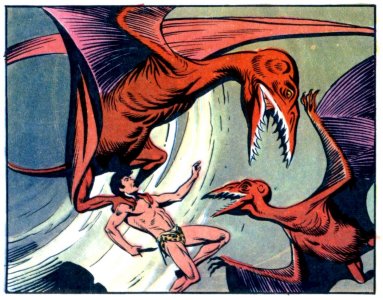
Burne Hogarth sucede precisamente a Harold Foster (que passa a dedicar-se, em exclusivo, a partir de Fevereiro de 1937, à sua famosa criação, o herói medieval "Prince Valiant") na ilustração das páginas dominicais de "Tarzan". Assim, a partir de 9 de Maio de 1937 e durante 13 anos (apenas interrompidos durante um período de pouco mais de 1 ano), Hogarth trabalha de uma forma entusiástica e apaixonada, conferindo a "Tarzan" um esplendor "barroco" nunca mais atingido depois dele, expondo o herói em poses anatómicas de grande plasticidade e dinamismo.


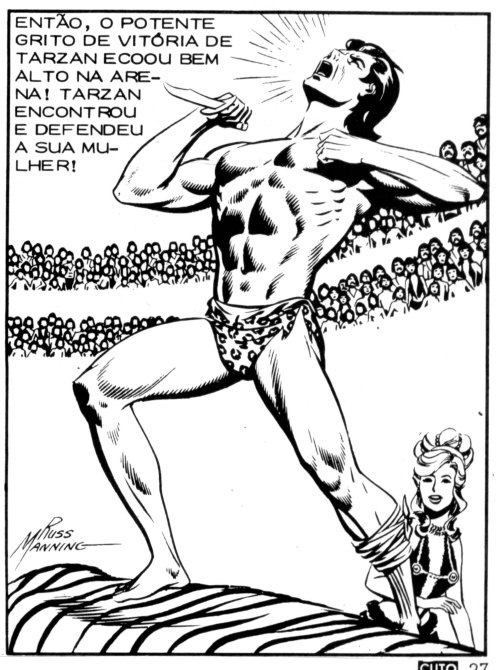
Russ Manning foi outro importante artista de banda desenhada que se ocupou da série "Tarzan" e foi, inclusivamente, de todos os autores, aquele que se manteve mais fiel ao espírito da obra de Edgar Rice Burroughs, tendo começado a desenhar "Tarzan" a partir do fim da década de 60, quer nas pranchas diárias, quer nas páginas dominicais.


Apesar de, desde 1929 até aos nossos dias, terem passado diversos autores e artistas pela série "Tarzan", nunca a figura do "Rei da Selva" foi tão exaltada e glorificada como pelo génio de três grandes mestres: Harold Foster, Burne Hogarth e Russ Manning. Na verdade, fica-se a dever, sobretudo, a estes três artistas norte-americanos uma das mais portentosas criações da banda desenhada mundial, que, além de dar outra dimensão ao mito criado por Edgar Rice Burroughs, renovou por completo a técnica, a estética e a temática das "histórias aos quadradinhos".

terça-feira, 11 de março de 2008

VINGADOR FANTASMA

The Phantom Stranger is a fictional character of unspecified paranormal origins who battles mysterious and occult forces in various titles published by DC Comics, sometimes under their Vertigo imprint.


The Phantom Stranger first appeared in his own series, publication date August/September 1952, by John Broome and Carmine Infantino. It lasted six issues. After an appearance in Showcase #80 (February, 1969), he received another series on May-June 1969 that lasted until February-March 1976. The first four issues (including the Showcase) consisted of reprints from both the Stranger's 50s title and the Dr. 13: Ghost-Breaker feature from the last nine issues of Star Spangled Comics at the same time, with new, brief framing sequences. These had Thirteen, certain that the Stranger was a fake, determined to expose him. Beginning with issue #4, November-December 1969, the comic went all-new, with stories produced by Robert Kanigher, Len Wein, Jim Aparo, Neal Adams, Tony DeZuniga, and others. In these stories, while the Stranger's past remained a mystery, the writers added a semi-regular cast of characters for him. A blind psychic named Cassandra Craft (first appeared in #17, January-February 1972) would assist him, an alchemist/sorcerer named Tannarak (first appeared in #10, November-December 1970) was first an enemy and would later assist him against the Dark Circle (first appeared in #20, July-August 1972) and a demonic sorceress named Tala (first appeared in #4) would become his major personal enemy. The stories hinted at a romantic attraction between the Stranger and Craft, but he eventually left her, deciding she could not be part of his life, convincing her he had been killed in their final battle against the Dark Circle (#24, March-April 1973). She eventually learned differently and turned up occasionally. Doctor Thirteen, dropped along with the reprints, was given a back-up series here as of #12, March-April 1971, which morphed into The Spawn of Frankenstein in #23, January-February 1973.

However, the Stranger is better known for his role as a supernatural assistant to other heroes, such as the Justice League. The League offered him membership, though he initially left before accepting. This leaves the actual date of his admission unclear. He was not, as some accounts have reported, a mere honorary member. After a vote of the majority of the League at the time, Superman declared the Phantom Stranger "a member" without qualification. (Justice League of America #103). The Stranger twice asserted his membership status when other Leaguers challenged his input, particularly during the vote on the League's re-admission of Wonder Woman. She would later confirm his membership status in a subsequent League adventure. He also affirmed his membership in the JLA/Avengers mini-series when the League doubted he was there to help.

The Stranger also starred in a miniseries in 1987. This series portrayed him as an agent of the Lords of Order. For refusing to help them in their war against the Lords of Chaos, they temporarily stripped him of his powers. This series also featured Eclipso as an agent of Chaos. However, no stories have referenced these events since, and they might no longer be in continuity due to the reality-alterations during Zero Hour and Infinite Crisis.

Origin
The most striking aspect of the Phantom Stranger is that his name, his true nature, and his origins have never been revealed. DC produced a special issue of Secret Origins that gave him four different possible origins:
One tale postulated that the Stranger was a fallen angel who sided with neither Heaven nor Hell during Satan's rebellion and thus condemned to walk the Earth alone for all time. Alan Moore wrote and Joe Orlando illustrated this story. This is also backed by The Word who said that the Phantom Stranger was a fallen one.
Another proposes the Stranger was originally a private citizen during biblical times and was spared God's wrath. An angel was sent to deliver him from divine wrath. After questioning God's actions, he commits suicide. The angel forbids his spirit from entering the afterlife, reanimates his body and condemns him to walk the world forever to be a part of humanity but also forever separated from it. He then discovered his divine charge, to turn humanity away from evil, one soul at a time.

In a variation of the Wandering Jew story, he was an adult family man named Isaac with a wife (Rebecca) and boy at the time when Jesus was a small child. When King Herod sent his army to kill all small male children (in an effort to slay Jesus) the army slew his son and wife. Blind with anger, he spent the next 30 years in a rage against Jesus. As Jesus was being tortured, Isaac bribed a guard to assume his role in whipping Jesus. Jesus then sentenced him to walk away from his home and country; to be errant until Doomsday. Eventually, his misplaced rage expunged, he spent the rest of his time helping society, even declining God's offer to release him from his sentence.

The last was a proposal that the stranger is a remnant of the previous universe. At the end of the universe the Phantom Stranger approaches a group of scientists studying the event, warning them not to interfere in the natural conclusion of the universe. The story concludes with the Phantom Stranger passing a portion of himself to a scientist, the universe is reborn, and the scientist from the previous universe is the Phantom Stranger in the new universe (a recursive origin?). This origin shares similarities with that of Galactus.

Three out of four of these origins rely specifically on Judeo-Christian concepts, which rarely figure into the origins of most comic book characters. In the comic book miniseries The Trenchcoat Brigade, John Constantine sees that the first origin story is essentially correct. Note however that the continuity between DC's mainstream books and Vertigo has never been very clear, and that the 1987 miniseries points to a different origin for the Stranger.

Another possible origin was hinted at in The Kingdom (the sequel to Kingdom Come) in which it was implied that Jonathan Kent, the future son of Superman and Wonder Woman, might grow up to be the Phantom Stranger. This also tied some of his abilities into the Hypertime concept, saying that he had the innate ability to enter other alternate timelines and to exist in the spaces between them. However, the story ultimately revealed this a red herring. The character in question had been deliberately drawn in shadows to suggest that he was the Stranger; but when Wonder Woman finally saw his face, she said that she now realized he was not the Stranger.
Yet another story, in the mini-series Conjurors, has him as the Father of Magic, the first human ever to wield arcane forces through his medallion, which he had stolen from extradimensionnal Lovecraft-type deities, arcane forces he then shares with humanity.

A stranger...
In his earliest appearances, the Phantom Stranger would prove supernatural events to be hoaxes. In later stories, the supernatural events were real and the Phantom Stranger was given unspecified superhuman powers to defeat them. He later appeared in various other DC Universe titles, sometimes as a major participant; in others, the Phantom Stranger just appears and gives advice or warning to the featured heroes. Occasionally he serves simply as narrator. In some stories, he seems to be answerable to a mysterious Voice, implied to be God. It should be noted though that within the DC Universe, stories commonly identify, either at the time or after the fact, mysterious, benign Voices as the Lords of Order. (An example of this is the origin of Hawk and Dove.)

The Phantom Stranger played a major part in Neil Gaiman's The Books of Magic, taking protagonist Tim Hunter through time to show him the history and nature of magic. He has assisted the Justice League on numerous occasions, even being formally elected to the group in Justice League of America #103 (although he did not acknowledge his membership until Justice League of America #143). The Stranger also had his own limited series, where lacking much of his power, he tries to foil Eclipso's plan to cause a nuclear war.

The Stranger in a typically cryptic pose. Art by Neal Adams.
He also, during Kevin Smith's relaunch of Green Arrow, attempted to prevent Hal Jordan from uniting the resurrected body of Oliver Queen with his soul in Heaven. This earned him Jordan's wrath; indeed, the Spectre threatened to judge the Stranger to see whether God had "punished" him properly by refusing him access to Heaven itself. Nonetheless, the Phantom Stranger assisted Hal Jordan during his tenure as the Spectre on numerous occasions as well, most notably in a short stint babysitting Hal's niece, Helen.

In 2005's Day of Vengeance, the Stranger had been turned into a small rodent by the Spectre. He was still able to advise the Detective Chimp, who sheltered him in his hat while he recovered his powers. He changed back using recovered energies in Day of Vengeance #6 and aided the Shadowpact, allowing them to see the battle between the Spectre and Shazam. The series makes a point that the supernatural community generally regards the Phantom Stranger as invincible. The first reaction of some characters to the Spectre's assault on magic is simply to presume that the Stranger will take care of it. Other stories have shown the Stranger nearly as powerful as the Spectre. This however, is a recent interpretation. While others have never considered the Stranger as an easy foe to combat, given his unknown abilities, they also never considered him as invincible, though it's conceivable that fellow magic-wielders would have a better sense of his powers than "outsiders."

In the Day of Vengeance: Infinite Crisis Special, The Phantom Stranger works with Nabu, Doctor Occult, Zatanna, the Shadowpact and other mystics to re-form the Rock of Eternity and help defeat the maddened Spectre.

The Phantom Stranger's relationships with the other mystic heroes are usually a bit tense. The Stranger has no qualms gathering various forces in order to combat a certain evil (the Sentinels of Magic, but also other loose outfits), often invading those people's personal lives. However, he does not usually extend them that same courtesy. The Phantom Stranger has resisted such people as Doctor Fate (notably Hector Hall) in this, although Fate is in almost any incarnation an ally of the Stranger. Despite this, he does get along well with Zatanna; in Justice League of America #6 he appeared by her side to help remove the influence of Faust on Red Tornado, and in the Justice series he seems to have a fatherly affection for her, calling her "my dear."

Since he is ultimately an unpredictable force, others often meet the Phantom Stranger's appearance with distrust. Nonetheless, most heroes will follow him, seeing not only his immense power, but also knowing that the Stranger is in the end, a force for good. Notable though is Madame Xanadu, who has refused to join the Stranger on a few occasions, although she is a member of his Sentinels of Magic.

The Stranger also holds a unique relationship with the Spectre, as the two forces often come into conflict. He was responsible for gathering a group of mystic heroes in order to combat the Spectre, when its human host Jim Corrigan seemingly lost control of the Spectre. (It was during this time that they destroyed the country of Vlatava.) The Phantom Stranger participated in Jim Corrigan's funeral, when Corrigan's soul finally earned its rest and left the Spectre. The Stranger subsequently became one of the forces that stood against the Spectre when it went on a rampage without its human host, until the soul of Hal Jordan bonded with it. The Stranger occasionally took on an advisory role for this new Spectre. In Infinite Crisis #6, aware that the Spectre now has yet another new host, the Phantom Stranger gathered a large group of magic wielders in an unsuccessful attempt to solicit the Spectre's assistance in the Crisis.


Powers and abilities
The natures of these are as mysterious as the Stranger himself, who seems to be effectively eternal, never aging. The Phantom Stranger has demonstrated enormous powers and capabilities, the exact origin of which is undetermined. He can travel enormous distances in a very short period of time, such as to the JLA Watchtower and Apokolips, as well as to mystical dimensions, such as Heaven, Hell and the realm occupied by the Quintessence. He can fire energy bolts of great force, travel through time, dispel magic, reveal illusions, and survive in space without earthly life-support systems. His power seems to have unspecified parameters limiting them. In many cases, despite his obvious capabilities, he claims he is not allowed to end a crisis directly, only to guide others to take the necessary actions. (This restriction allows the Stranger to guest-star in virtually any title without becoming a deus ex machina whose actions would immediately end the story.) He claims that "nothing remains hidden to him."

In Day of Vengeance #2, the Spectre transforms the Stranger into a rodent, rather than killing him outright, because even the Spectre's power would be insufficient to kill the Stranger.
Contrary to some trick-of-the-light impressions, the Phantom Stranger does not wear a mask; instead, the shadow of his hat almost constantly cloaks his eyes.

Other version
The Phantom Stranger appears in his animated form in the following comics:
Batman Gotham Adventures #33 (Wherein he shows Bruce how Gotham City would be without Batman.)
Justice League Adventures #31 (He shows three possible fates about a boy who is mourning his family.)
Justice League Unlimited #14 (Helps Deadman and some other leaguers against a magical threat.)
Justice League Unlimited #28 (Shows the Flash several Christmas days Batman experienced in the past, in order to give the Flash a deeper understanding of Batman's psyche)


References
Index to the Stranger's Earth-1 adventures
The Unofficial Phantom Stranger Chronology
Phantom Stranger webpage and FAQ
The Grand Comics Database Project - index for The Phantom Stranger vol. 1.
The Grand Comics Database Project - index for The Phantom Stranger vol. 2.
The Grand Comics Database Project - index for The Phantom Stranger vol. 3.
Phantom Stranger vol. 2 cover gallery


Retrieved from "http://en.wikipedia.org/wiki/Phantom_Stranger"

sexta-feira, 8 de fevereiro de 2008

HOMEM BORRACHA


Homem-Borracha


Homem Borracha (Plastic Man) é um personagem de história em quadrinhos (banda desenhada) publicado originalmente pela Quality Comics durante a Era de Ouro dos Quadrinhos. Ele foi criado por Jack Cole e apareceu pela primeira vez em Quality Comics número 1, publicada em agosto de 1941. Ele posteriormente receberia seu próprio título pela Quality, e vários outros mais tarde, quando seus direitos foram adquiridos pela DC Comics.

Poderes
O Homem Borracha tem o poder de esticar e moldar seu corpo no formato que quiser, um poder que seria repetido mais tarde em outros personagens como Senhor Fantástico e


Homem Elástico. Entretanto, ele é superior a seus predecessores por assumir formas aparentemente impossíveis, como objetos com partes móveis (carros e aviões com rodas e hélices que giram), hidrante que solta água, imã que atrai metal, lanterna que ilumina, etc.
Origem
O Homem Borracha era um bandido chamado Patrick "Eel" O'Brian (sendo Eel uma espécie de apelido, pois significa enguia em inglês. Não foi descoberto que seu nome era Patrick até recentemente), até que caiu em um caldeirão de ácido que lhe deu suas super-habilidades. Ele usa óculos escuros e um uniforme amarelo e vermelho, tão flexíveis quanto seu corpo. Qualquer forma que tome, suas cores permanecem as mesmas.
Filiações
O Homem Borracha foi membro da atual formação da Liga da Justiça, mas resolveu deixar a equipe, algum tempo atrás, alegando que gostaria de passar mais tempo com seu filho, Luke McDunagh. Sua situação atual junto a equipe não foi muito bem definida, permancendo um mistério se ele ainda está como membro ativo ou não. Entretanto, é estabelecido em algumas fontes que ele está ativo desde 1941, tendo sido membro do All-Star Squadron e sendo o elo de ligação do grupo com o FBI. Isto é no entanto amplamente discutido, dado que seu companheiro Woozy Winks, estaria envelhecido hoje. No entanto, como um herói de comédia, não se exige muito dele em questões de continuidade.
Desenho animado
Borracha teve seu próprio desenho animado pela produtora Ruby Spears em 1980. Chegou a passar no Brasil com o nome de Homem Elástico (um dos motivos porque os dois personagens são confundidos até hoje).


Fonte: Wikipédia, a enciclopédia livre
Links
Aqui o link para a abertura do desenho animado no Youtube.
http://www.youtube.com/watch?v=wIoHDB1FUOM
Obtido em "http://pt.wikipedia.org/wiki/Homem-Borracha"
Categorias: Liga da Justiça Heróis da DC Comics

domingo, 3 de fevereiro de 2008

ZÁS-TRÁS ?? OU STEEL STERLING


Lembro bem, quando pequeno, lí em papéis esmaecidos, numa revista de um sabonete chamado lifeboy, sobre este herói que chamava-se ZAS-TRAS, vejam esta matéria que compilei do sitio www.mightycrusaders.net:


Created by:
Abner Sundell & Charles Biro
Real Name:
John SterlingJoined Mighty Crusaders:
In an untold story prior to Archie's Weird Mysteries #3 First Appearance:
Zip Comics #1 February 1940
Origin: John Sterling, an experimenter who plunged his body into a cauldron of molten metal. That gave Sterling the powers of invulnerability and flight.
History:
MLJ Comics:
Like most people, John Sterling wanted to do something about smashing crime. His desire was made even stronger by the fact that he saw his father's fortune swindled out from under him by racketeers who later brutally murdered the elder Sterling. To be effective at smashing crime, he needed an edge. To quote the text of his first recorded case; "He knew that one man alone could not fight the law's battle against gangdom, unless this one man was forever protected against the underworld's bullets." (Zip Comics #1) He began a series of experiments to create a solution to make him invulnerable to any bodily harm. He finally came up with the chemical solution that would make him invulnerable, but there was a catch. The catch was that after coating himself with the solution, he had to dive into a vat of molten steel that had the solution mixed into it. He coated his body with the chemical solution and then added the solution into the vat of molten steel. He then dived into the molten steel, knowing that he could very easily die the instant his body hit the molten metal. But instead of being incinerated on the spot, Sterling survived and emerged unscathed. He found that his body had become as hard as solid steel giving him not only invulnerability but also limited super strength as well. He also found that by simply rubbing his fingers through his hair, his body could generate a magnetic field that allowed him to defy gravity practically giving him the power of flight. With his newly acquired powers, John Sterling launched his one man crusade against crime as the red and blue clad gangbuster known as Steel Sterling; the Man of Steel. In his first case, Steel Sterling went after a gang of bank robbers only to encounter the felon who was to become the most persistent of his early foes, the Black Knight. He was initially trapped by the Black Knight in a pit filled with huge rats, but he escaped by smashing hand and foot holds in the wall with his steel-hard fists and climbed out of the pit in order to confront the Black Knight. Sterling left the felon to die as his booby-trapped castle exploded and apprehended the Black Knight's men as they tried to escape from the castle's destruction, retrieving the stolen money as well. He left the captured felons with the police as he left the scene on a "borrowed" police motorcycle (Zip Comics #1). The Black Knight would escape from the exploding castle and would return to bedevil Steel Sterling four more times in the course of Sterling's first year in the crime-fighting profession. Shortly after their first encounter, the Black Knight broke out a group of criminals from a maximum security prison and used his new hirelings in a daring hijacking of a huge gold shipment from Alaska. Sterling tracked down the Black Knight and his men to his hidden Artic fortress, only to be incapacitated with tear gas and weighed down by heavy chains. Sterling escaped from the fortress and later apprehended the Black Knight and his men and recovered the stolen gold (Zip #2). He would also smash the Black Knight's plot to conquer the nation of Brazoria in South America (Zip #3); break up his plot to steal shipments of Radium from various hospitals (Zip #4); and finally, smash his plots to commit acts of sabotage using a "zeta ray" (Zip #5). During this time, Steel Sterling - as John Sterling - became a private detective and created the deception that he and John Sterling were twins in order to divert any unwanted attention from the underworld or from the authorities. He helped improve his relations with the law-enforcement community by befriending a few police officers during his work as a private eye, most notably a stocky, Irish-American patrolman known as Clancy. A woman named Dora Cummings managed to come into his life as well. She more often than not showed distain for John's less-than-sterling (no pun intended) attitude (which was part of Steel's ruse). They were soon joined by former circus fortune teller turned would-be PI Alec Ben "Looney" Lunar. The gauntly built Lunar would act as a Stan Laurel to Officer Clancy's Oliver Hardy and to Steel Sterling, they would turn out to be more of a hindrance than a help. Incidentally, Steel Sterling would have a hand in launching the career of another noted superhero; Inferno, the Flame Breather. But at the time they first met, Steel was tracking him down for activities he committed while he was on the wrong side of the law. Earlier, Steel Sterling had apprehended a crooked India-rubber man named Twisto for committing a series of murders in order to acquire the circus he worked at and to make his wife Lilli - a female lion-tamer - the star of the circus. Steel also managed to prevent him from killing Lilli (by turning the big cats she worked with into killers by feeding them meat tainted with his own blood) and Dora Cummings (By trying to stab her) as well (Zip #9). Twisto escaped from jail shortly afterward and forced Inferno - a fire eater - and Hefto - a strongman - to work with him by threatening to turn them in for their past crimes. With his two reluctant partners, he planned a series of crimes that would bring the city to its knees. Their first crime was to eliminate John Sterling. Steel -as John Sterling - learned of their plan to kill him through Looney and he successfully faked his own death by their hands by allowing them to ram him against a wall with a truck. Thinking Sterling was dead, the "unholy three" (as Sterling called them) began plotting their next move. Steel then broke out of his grave and quickly contacted Dora Cummings. He revealed to her that he and John Sterling were one and the same and the reasons for the ruse. He also explained how he was able to fake his own demise (through catalepsy, an ability that allowed him to stop his heartbeat at will). After he explained all that to Dora, he waited for the trio to make their next move. He didn't have to wait for long, as Twisto and his two accomplices managed to take over the local power plant and cause a power blackout that left the city open for them to loot at will. Sterling arrived at the power plant and fought against the trio. During the battle, Twisto and Inferno escaped after Inferno temporarily blinded Sterling with a blast of flame from his mouth. Hefto perished while trying to escape from Sterling when he fell from a balcony while trying to leap from one balcony to another. With Twisto and Inferno still on the run, Steel found himself with the difficult task of tracking them down before they could cause any more harm (Zip #10). Fortunately Steel managed to pursue both Twisto and Inferno. He managed to apprehend Twisto and tailed Inferno to a dive in the seedier side of the city. Using a disguise, Sterling managed to gain Inferno's confidence which led to Inferno deciding to reform and turn himself in for his crimes. But before they could make any moves, they ended up coming across a criminal named Pig Panwood, better known as the Rattler, one of the earliest "super-villains" to emerge. They fought against the Rattler, but Steel allowed the villain to escape in order to save Inferno from dying from the poison that the Rattler injected him with (Zip #11). They managed to pursue the Rattler as he tried to rob a fur warehouse. But he managed to elude capture by injuring Inferno once again. They got wind of the Rattler's latest scheme through Dora Cummings after she checked out a suspicious novelty jewelry store that opened next to the U.S. Sub-treasury. They found that the Rattler and his men were building a tunnel underneath the sub-treasury and planned to rob it after the tunnel was completed. Steel and Inferno managed to fight and apprehend the Rattler and his men just as he was about break into the sub-treasury. Inferno then turned himself in to the authorities wanting to pay his debt to society for his previous crimes (Zip #12). Shortly after leaving prison, Inferno - on the advice of the judge who presided over his trial and in emulation of Steel Sterling - donned a colorful red and yellow costume and used his fire-breathing powers to launch a career as a crime fighter (Blue Ribbon Mystery Comics #13). Surprisingly, Steel Sterling not only managed to become a vigilante who the police and the government approved of, he also managed to become a major celebrity in the process. His newly acquired celebrity status led him to be asked by the U.S. Government to make a goodwill tour of South America as part of the Good Neighbor Policy of that period. So with Clancy and Looney along for the ride, Steel began traveling throughout South America acting as a goodwill ambassador for the U.S.A. . During his travels, he began smashing plots by Nazi German agents in that region. He first smashed plans by Nazi agents to discredit him and the U.S., in order to win a vital commercial airline contract for Germany (Zip #19). He then found himself trying to find a hidden Nazi airbase in South America that was being used to attack Allied shipping in that region, which he eventually found and destroyed (Zip #20). His most unusual mission took him to Japan before the attack on Pearl Harbor. Shortly before that attack, Premier Itoki - a high ranking Japanese official - warned his fellow officials that an attack on Pearl Harbor would be tantamount to suicide because of fear of bringing the full wrath of the United States armed forces on them. He threatened to bring others in the government to turn against the militarists in the Diet (the Japanese Parliament). But Baron Watanabi - another official - had other plans. He had Itoki's grandson kidnapped and succeeded in framing Clancy and Looney for the crime. By showing that Americans were not to be trusted, Watanabi gained Itoki's trust and had him sign the declaration to launch the Pearl Harbor attack. Steel Sterling found out about the kidnapping and not only managed to find Premier Itoki's grandchild, he also managed to save Clancy and Looney from being executed by a firing squad. He then explained the frame-up to Premier Itoki who then dragged a confession out from his maid by threatening to destroy her husband's "belt of a thousand stitches" (which in the Japanese culture and the Shinto faith would cause the destruction of her husband's honor and his soul). She confessed about the plot and Itoki went to confront Watanabi in the Diet and get him to retract the orders to attack. Watanabi then killed Itoki by stabbing him in the back and allowed the attack on Pearl Harbor to commence. Steel then went to the Diet only to find Premier Itoki dead with Baron Watanabi's dagger in his back. After hearing Emperor Hirohito's announcement of the attack on Pearl Harbor, Steel promptly flew to the Emperor's palace and attacked the Emperor and his aides as they announced the attack. He then shouted the following speech to the assembled Japanese; "Roar like a lion, now! But you soon will be mewing like sick cats when we get through with you! You called the turn - we tried to shake hands across the ocean and you thought you saw a swell chance to slip the cuffs on us! "Okay, make the most of your inning - our time at bat will come soon. My Uncle Sam has a funny way of remembering things!" "And just to make myself clear, here's a language you and your scavenger Nazi friends will soon understand to your everlasting sorrow!" He spoke as he skywrote a V and ... - (the Morse Code sign for the letter V) and flew off. Thus began Steel Sterling's personal war against the Axis (Zip #26). After the incident in Japan, Steel Sterling began his one man war against the Axis in earnest both on the home front and abroad. Among his celebrated battles with Axis forces include such missions as the occasion in which he - aided by Sgt. Alec "Looney" Lunar - paved the way for an Allied invasion of North Africa by smuggling in several key Allied commanders and in the process wrecking a Nazi plot to kill them (Jackpot Comics #8). He would also travel to occupied France to investigate a series of murders by a werewolf which turned out to be a Nazi plot to obtain skin and bone grafts by murdering French citizens (Zip #32). In addition, he helped save the life of the nephew of a Chinese scientist from being killed by Japanese agents and kept the scientist's invention from falling into the hands of the Japanese (Zip #36). Not to mention three encounters with the most persistent of his later foes, the Nazi agent known as Baron Gestapo (Zip #s 27 & 28, Jackpot #6). Throughout his career, Steel Sterling encountered many colorful criminals, including some of the earliest "super villains" to appear on the scene. After the Black Knight and Baron Gestapo, his foes included such felons as Twisto, the Puppet Master, the Rattler, and the Hyena among others. The celebrated career of Steel Sterling lasted until the end of World War II. After that, his postwar life became shrouded in rumor. These rumors started when Steel began resurfacing in later years, still looking much like he did back in the 1940's. Besides fighting evil on his own, he also aided the Mighty Crusaders on two occasions, the second time as a member of a Crusaders offshoot group - along with Mr. Justice and the Jaguar - called the Terrific Three (The Mighty Crusaders [first series] #s 4 & 5). According to some, the Steel Sterling who showed up in recent years was the original or was a descendant of the original. If the Steel Sterling who showed up in recent years was the original of the World War II era, his still youthful appearance could be easily explained by the fact that the chemical and steel bath that gave him his superpowers had somehow slowed his aging process to a trickle. Whatever the case may be, the world has definitely not seen the last of Steel Sterling.

Powers & Weapons:
Steel Sterling has magnetic powers, muscles of steel and he has virtually invulnerable skin and the ability to fly.
Checklist:
MLJ Comics:
Zip Comics 1-47Jackpot Comics 1-9Roly Poly Comics 1, (2-15?)
Mighty & Radio Comics:Archie...Archie Andrews, Where Are You? Digest 9Fly Man 39 (1st Silver Age app. 9/66)Mighty Comics 44, 46, 49Mighty Crusaders 4, 5, 7
Red Circle & Archie Comics:Blue Ribbon Comics (vol. 2) 3Mighty Crusaders (vol. 2) 9, 10Shield 1, 2Shield/Steel Sterling 3Steel Sterling 4-7Archie's Weird Mysteries 3, 14

Tocha Humana Original


O primeiro Tocha Humana foi um andróide inflamável, que surgiu em 1939 na revista Marvel Comics n.º 1. Seu autor foi Carl Burgos. Era uma das histórias mensais da revista Marvel Mystery Comics. Depois, a popularidade do herói flamejante o levou a estrelar sua própria revista. Em 1949, as histórias foram interrompidas, regressando por um curto período entre 1953/1954.

Origem
O Tocha Humana Original foi criado por Phineas T. Horton, havendo uma versão de que a tecnologia usada pelo inventor foi a de Kang, o conquistador (um super-vilão do futuro). O andróide lutou na Segunda Guerra Mundial e depois chegou a aparecer em aventuras na Guerra da Coréia. Assim como os outros heróis da Era de Ouro, o Tocha Humana tinha o seu parceiro, o mutante Toro, conhecido no Brasil como Centelha. Surgido na revista própria do Tocha, Centelha ganhou seus poderes ao sofrer a contaminação radioativa adquirida no trabalho de seus pais, que eram cientistas nucleares.

Na década de 60 surgiu o segundo Tocha Humana, integrante do Quarteto Fantástico, um jovem humano que ganhou os poderes em um acidente durante uma viagem espacial.
Nos anos 70 a dupla Tocha Humana Original e Centelha apareceria em novas histórias, ambientadas na Segunda Guerra Mundial, ao lado do Capitão América, Namor e novos personagens como Union Jack e Spitfire, formando o grupo de super-heróis denominado "Os Invasores".
Nos anos 80, John Byrne recontaria a origem do andróide, mostrando que a capacidade de se inflamar não estava prevista pelo seu criador. Sua intenção era criar vida artificial. Devido a essa falha, ele foi desativado e o inventor tornou-se desacreditado.


Era Moderna
Ao mesmo tempo que o segundo Tocha Humana vivia suas aventuras, o Tocha Humana Original ressurgiu em 1966, quando enfrentou o Quarteto Fantástico, enganado pelo vilão Pensador Louco.
Depois especulou-se que o personagem Visão, o sintozóide (Visão era o nome de um personagem criado por Jack Kirby na era de ouro) dos Vingadores fosse o Tocha Humana Original reconstruído. Uma sequência de histórias dos Vingadores escritas por Roy Thomas, que lidavam com o passado secreto do Visão, revelou gradualmente que o corpo do Tocha havia sido encontrado pelo robô renegado Ultron 5 e modificado para se tornar o Visão, sua memória havia sido apagada e seus poderes alterados com a ajuda forçada do criador do Tocha, o professor Phineas Norton. Em outra história, mostrou-se que isso não era a verdade: o corpo do Visão seria um protótipo do Tocha Humana Original, roubado pelo Ultron 5. A semente dessa idéia de reformular a origem havia sido plantada pelo artista Neal Adams e desenvolvida em detalhes pelo escritor dos Vingadores #133-135, Steve Englehart.
Em uma estória de Namor nos anos 60, escrita por Roy Thomas, o Príncipe Submarino enfrenta o que seria o Tocha Humana Original, revivendo os confrontos dos dois nos anos 40. Depois ele descobre que seu oponente era na verdade Centelha, que havia sido enganado por outro vilão para atacar o princípe submarino. Nessa estória, Centelha acaba falecendo.
O verdadadeiro andróide encontrava-se desativado, até que nos anos 80 reviveu e entrou para os Vingadores da Costa Oeste.
Uma história posterior de Roy Thomas em "What If 4" (agosto 1977), plantou a sugestão de que o Visão teria sido feito na verdade a partir de um segundo andróide criado por Norton, chamado Adam II. Isso liberava o Tocha Humana para um possível retorno. Essa idéia foi seguida por John Byrne, que fez a Feiticeira Escarlate reviver o Tocha em uma aventura dos Vingadores da Costa Oeste (West Coast Avengers), procurando respostas sobre seu marido, o Visão, tanto para si quanto para ajudar Ann Raymond, a esposa do Centelha. O Tocha atuou com os Vingadores da Costa Oeste por vários números antes de perder seus poderes para salvar a vida da ex-heroína Sptifire na série de Namor, nos anos 90. Sem poderes, o Tocha hoje vive com Ann Raymond e adota a identidade do humano Jim Hamond.


O Tocha Humana Original tem destacada participação na mini-série Marvels, de Alex Ross. Em belos desenhos são mostradas a sua origem, os confrontos com Namor e a participação no grupo Os Invasores, que lutou contra os nazistas durante a II Guerra Mundial.


Fonte: Wikipédia, a enciclopédia livre.

Links
Tocha Humna no International Hero


sábado, 2 de fevereiro de 2008

Flash Gordon


Flash Gordon é o segundo herói espacial das histórias em quadrinhos (o primeiro foi Buck Rogers), criado por Alex Raymond em 7 de Janeiro de 1934.


Em 1933, a King Features Syndicate abriu um concurso para descobrir personagens de quadrinhos que rivalizassem com Buck Rogers e Tarzan de sua concorrente, a Pulitzer Syndicate. Alex Raymond se inscreveu e ganhou, passando a desenhar Flash Gordon e Jim das Selvas (que completava a página) para o New York American Journal, a partir de um domingo, 7 de Janeiro de 1934. Poucas semanas depois, Raymond passaria também a desenhar o Agente Secreto X-9, outra encomenda da King Features para contrabalançar o sucesso de Dick Tracy, da Pulitzer.
No Brasil, o primeiro capítulo (ou "prancha") de Flash Gordon no Planeta Mongo foi publicado no nº 3 do Suplemento Infantil do jornal A Nação, do Rio de Janeiro, em 28 de Março de 1934 (a partir do nº 15, o Suplemento passou a circular de forma independente com o título de Suplemento Juvenil). Depois de mais de 80 capítulos publicados em página dupla no Suplemento, em 1937 decidiu-se pela publicação de um álbum de luxo, contendo as primeiras 60 pranchas, do qual foram impressas três tiragens de 5000 exemplares, vendidos com absoluto êxito. Em 1987, a EBAL de Adolfo Aizen (fundador do Suplemento Juvenil) publicou uma edição comemorativa dos 50 anos do lançamento do álbum original.

Cronologia de Flash Gordon no Brasil
Em 28 de Agosto de 1934, Flash Gordon começa a ser publicado no tablóide Suplemento Juvenil (editado no Rio de Janeiro, mas com distribuição nacional).
Em 27 de Fevereiro de 1936, o Suplemento Juvenil publica o livro Flash Gordon no Planeta Mongo, reunindo pranchas publicadas anteriormente no tablóide.
Em 21 de Maio de 1938, é publicado o livro Flash Gordon no Reino das Cavernas, primeiro volume da Biblioteca Mirim (uma "cria" do Suplemento Juvenil). Em Agosto de 1939, Flash Gordon passa a ser publicado no Globo Juvenil, do jornalista Roberto Marinho, que adquiriu todos os direitos para o Brasil dos personagens distribuídos pelo King Features Syndicate.


Bibliografia
SILVA, Diamantino da. Quadrinhos dourados: a história dos suplementos no Brasil. São Paulo, SP:Opera Graphica, 2003.

quinta-feira, 31 de janeiro de 2008

NOVELAS GRÁFICAS & HQ

Os Quadrinhos, durante algum tempo, têm influenciado a mente e os pensamentos, devaneios e fantasias de muitos... Muita crítica se fez a esta forma de expressão que agora tem na crítica especializada o nome de novela gráfica!!

E é a respeito desta forma que vamos falar dela através dos tempos.... aguardem as postagens!

LANCELOT